


Bitcoin IRA
Building the demand engine behind a new investment category
Prior role: Director of Demand Generation at Bitcoin IRA, January 2017 to April 2018.
$117.9M
Investment volume
May to December 2017
2,067
Unique investors
May to December 2017
$26.7M
Peak month
December 2017
4.2×
Monthly ad spend growth
$200K to $839K, September 2017 to January 2018
Role: Director of Demand Generation, leading paid media, partners, landing pages, and lead flow. Investment volume is what investors paid, including fees: a company total, not revenue. Excluding orders that may be buybacks, it is $105.9M+.
Overview
Bitcoin IRA let investors hold cryptocurrency inside retirement accounts, at a time when most of them were still learning what Bitcoin was. The work built and ran its demand generation, first as consulting and then in-house from January 2017 to April 2018. From May to December 2017, 2,067 investors placed $117.9M in orders, peaking at $26.7M in December.
Bitcoin IRA was not a Reg CF, Reg A+, or Reg D offering, so this page reports investment volume rather than capital raised. The marketing problem is one a raise shares: an unfamiliar financial product, investors who need education before they act, and a sales team that depends on the quality of its leads.
The challenge
A new category with no playbook
Bitcoin IRA had a first-mover product, but the market was early. Mainstream retirement investors needed education, reassurance, and repeated exposure before they would consider moving retirement funds into digital assets. Clicks alone would not do it: investors had to understand the product, trust the company, and believe crypto could belong in a retirement strategy.
The company also needed enough qualified leads to feed a growing sales team, without spend outrunning what that team could call, qualify, and close.
Goals and scope
Goals
- Capture investors already searching for Bitcoin and retirement investing
- Teach a broader personal finance audience that crypto could be held in a retirement account
- Build credibility for a new kind of financial product
- Give a growing sales team enough qualified leads
- Scale paid media while tracking results to funded accounts
Scope
- Demand generation
- Paid media
- Landing pages
- Affiliate and publisher partners
- Investor messaging
- Lead scoring and allocation
- Channel reporting
Teams coordinated
- Sales leadership
- Closing agents
- Affiliates and publishers
The playbook
The demand engine
-
Repositioned the brand and website for a mainstream audience
The work started as consulting on brand, the website, and paid media. The redesign made the product easier to understand for a mainstream retirement audience and supported the initial market launch. As channel performance accelerated, the work grew into full-time ownership of lead generation in January 2017.
-
Captured high-intent search demand
Search campaigns targeted Bitcoin IRAs, crypto retirement, and 401(k) rollovers, with refined negative keyword lists and connected Search, Display, YouTube, and Gmail campaigns. Custom tracking tied paid media to Salesforce, so campaigns were judged on funded retirement accounts rather than clicks. Google Search ($17.1M) and Google Display ($16.3M) were the two largest tagged sources of investment volume from May to December 2017.
Forbes credited "first-mover advantage and aggressive Google advertising campaigns" for Bitcoin IRA's presence in the category.
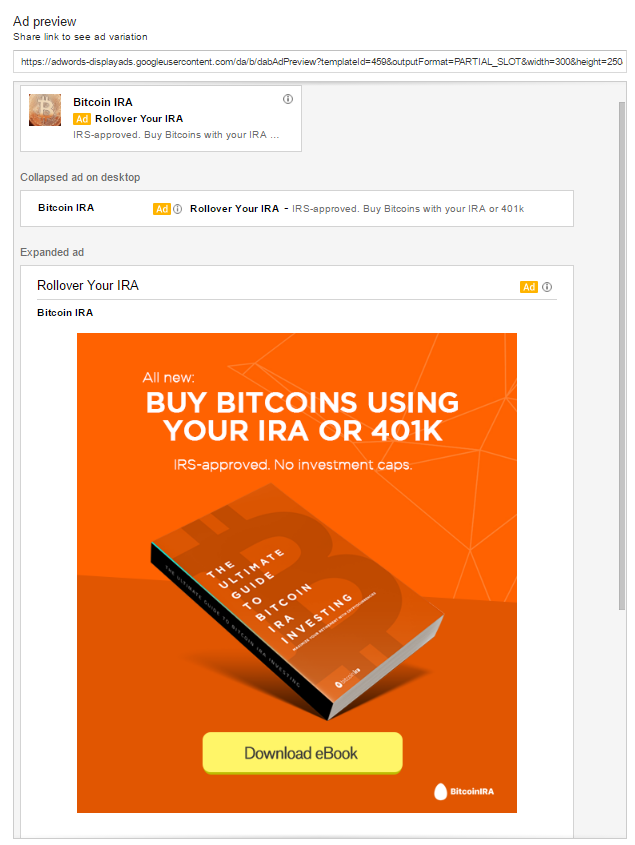
A Google display ad from May 2017. Claims in the ad were Bitcoin IRA's own at the time. -
Tested channels widely and moved budget to what funded
Beyond Google, the mix included Bing, Yahoo Gemini, Facebook, Twitter, Quora, native placements, retargeting, ad networks, direct publisher deals, and a radio test, reaching both mainstream finance and crypto-native audiences. Performance by channel, platform, and source showed where funded accounts came from, and budget moved there.
Monthly ad spend grew from $200K in September 2017 to a peak of $839K in January 2018, 4.2 times in four months. Actual ad spend from July 2017 to May 2018 was $5.26M.
-
Launched the affiliate and partner program
A new affiliate marketing department built relationships across 100+ media, influencer, crypto, and financial-services sources, including direct publisher deals with CoinDesk and Investing.com. Partners gave an unfamiliar product reach and credibility. The channel brought in $4.07M in verified investment volume from May to December 2017, then $2.63M in February 2018 alone, 23% of that month's purchases.
-
Built and tested the landing pages
Landing pages for crypto retirement investors were refined with heatmaps, click tracking, page testing, and funnel analysis. The messaging mattered as much as the layout: the product had to make sense to a mainstream audience, and each page change was tied back to lead volume and sales capacity.
-
Worked the sales floor and set lead allocation
Time with the sales team showed whether new leads were contactable, qualified, and ready for an advisor conversation, and that feedback changed campaigns and follow-up. A lead-scoring and allocation engine matched leads to each person's capacity and conversion performance instead of routing every inquiry equally. That lead flow supported 23 to 29 closing agents.
Key moves
What changed
- A brand and website rebuilt for a mainstream retirement audience
- Search, display, and retargeting tracked through Salesforce to funded accounts
- Budget moved by channel, platform, and source as funded accounts came in
- An affiliate program across 100+ media, influencer, crypto, and financial-services sources
- Landing pages refined with heatmaps, click tracking, and testing
- Lead allocation matched to each closer's capacity and performance
Results
The numbers
Each figure comes from a reconciliation of Bitcoin IRA's order data, CRM lead export, and marketing budget.
$34 to $43
Investment volume per $1 of ad spend
August to December 2017, blended across all sources
26%
Investors who reinvested
May to December 2017, bringing in 48% of volume
$11.35M
New and reload purchases in one month
February 2018, a falling market, 15.3× ad spend
$4.07M
Partner channel investment volume
May to December 2017
1.9%
Unique leads who became investors
80,165 leads, 1,511 investors, July 2016 to November 2017
23 to 29
Closing agents supported
2017 through February 2018
Results in detail
What the numbers mean
The $117.9M is gross order volume from May to December 2017: what investors paid, including Bitcoin IRA's fees. It is not revenue. Of those orders, 268 worth $11.95M carried a fee of 5% or less, the flat rate later used for buybacks, so the conservative purchase figure is $105.9M+.
Bitcoin's price rose from about $4K to about $19K over the same period, and September to December made up 72% of the eight-month total. The market helped, and this page does not separate its effect from the marketing's.
The $34 to $43 per $1 of ad spend is blended: all sales divided by all ad spend. Spend is recorded when it was paid, not when the ads ran, so the figure is a range. 37% of the volume has no source tag, so each channel's figure understates its real contribution.
February 2018 was a falling market. Investors made $11.35M in new and reload purchases against $744K in ad spend. A further $9.54M in buybacks that month is counted separately.
Timeline
From consultant to Director of Demand Generation
About October 2016
Consulting began on the brand, website, and paid media.
January 2017
Lead generation moved in-house, under the Director of Demand Generation.
May to December 2017
2,067 investors placed $117.9M in orders.
December 2017
The peak month: $26.7M in investment volume.
January 2018
Monthly ad spend peaked at $839K, up from $200K in September.
February 2018
$11.35M in new and reload purchases in a falling market.
April 2018
My role as Director of Demand Generation ended.
Key learnings
Learning Experiences
- Education is part of acquisition. Investors have to understand an unfamiliar product and trust the company before an ad can do its job.
- Measure to funded accounts, not leads. Budget should follow what funds.
- Partners lend credibility where trust is the hurdle. Publishers and influencers reached investors that paid search could not.
- Marketing and sales run on the same lead flow. Time on the sales floor changed which media was bought and who received which leads.
FAQ
Questions about this case study
Why does this page say investment volume instead of capital raised?
Bitcoin IRA was not a Reg CF, Reg A+, or Reg D offering. Investors bought cryptocurrency through retirement accounts, so the figures are order volume: what they paid, including fees.
How much of the $117.9M came from marketing?
The figures do not say. The $117.9M is a company total, and 37% of it has no source tag. Where the page names a channel, the figure is what that channel's tagged orders brought in.
What is a buyback?
An investor selling coins back. Buybacks are not purchases, so they are kept apart where the data labels them, as in February 2018. The 2017 order file has no such label, which is why the page gives $105.9M+ as the conservative figure beside the $117.9M gross.
Can Grow Your Fintech do this work for us?
We work on the same parts of growth: positioning, customer education, paid media, partners, landing pages, and follow-up with the people who call or sign up. Your compliance team or counsel confirms what the marketing can say. A past result is not a promise of future results.
Who leads the work
The fintech growth consultant who's actually built, launched, and scaled fintech businesses.
Alex Wills is a fintech growth consultant with hands-on experience across high-growth agencies, private equity, real estate crowdfunding, crypto investing, RWA tokenization, B2B lending, and fintech fundraising. He's led go-to-market strategies, launched products and campaigns, scaled paid media and affiliate programs, managed investor relations, and built AI-powered marketing automations.
Having managed millions in advertising spend and led growth from inside financial businesses, Alex knows what it takes to turn ambitious goals into executable strategies. Whether you're preparing a product launch, struggling to acquire customers efficiently, or ready to scale, he brings the experience to identify what's working, uncover what's holding you back, and build a practical path forward. Every engagement is led directly by Alex, giving you senior-level expertise without the overhead of a full-time growth executive.